Compressed air feels free, and that is precisely why leakage quietly costs money for years. What does a compressed-air leak really cost you, and how do you work that out for your installation?
“It’s only air.” That thought runs deep, and it is wrong. Compressed air is an expensive form of energy in a factory. You generate it yourself with electricity, and a large part leaks away again through couplings, hoses, and valves. Small on their own, together a structural cost. On a 200 kW installation, that quickly adds up to 15,000 to 25,000 euros a year.
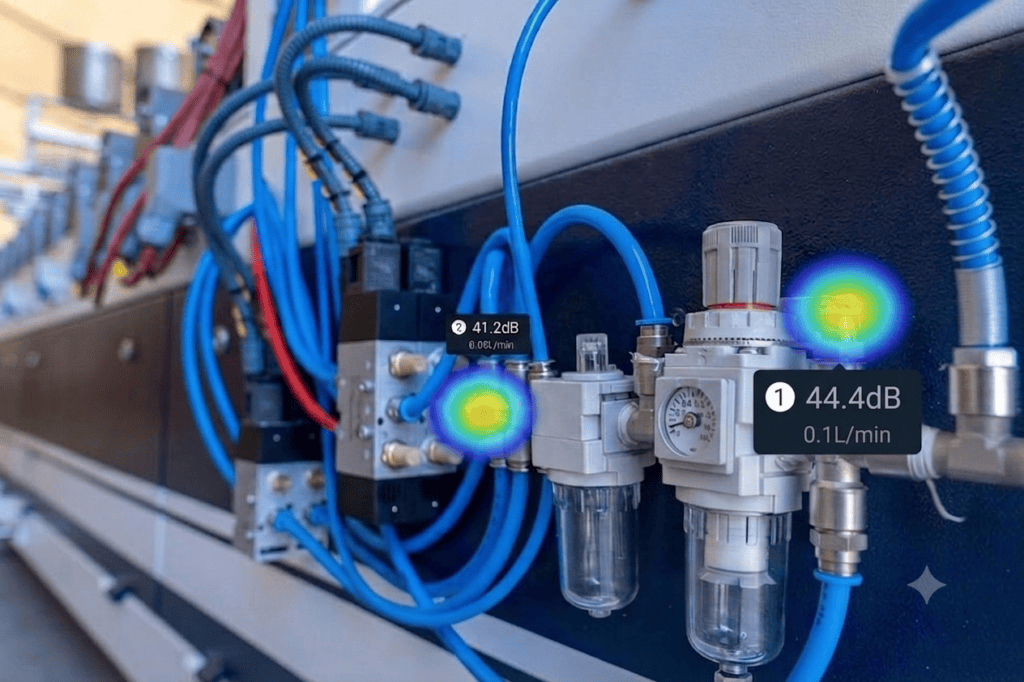
The sting is that you do not hear it. A compressed-air leak produces sound mainly in the ultrasonic range, above the limit of human hearing. In a running production hall all the more so. The leak is there; it costs money every day, and yet no one notices until someone goes looking for it.
Concretely, with our calculator, based on continuous operation, 7 bar, and the current electricity price of 26 cents per kWh. Five holes of one millimeter cost you around 6,000 euros a year in electricity. A single three-millimeter hole: more than 10,000 euros. And an average installation has not five but dozens of leaks. Fifteen small and five medium ones together add up to over 16,000 euros a year, plus 13 tonnes of CO₂. That is no rounding error, and it runs year after year until someone finds and fixes the leaks.
And that is exactly where it pinches: those figures are averages. “20 to 30 percent loss” and “15,000 to 25,000 euros” sketch the problem but say nothing about your situation. How many leaks do you have? How big? At what pressure, how many operating hours, and at what electricity price? Two comparable factories can differ by a factor of three. An average is a starting point, not an answer.
What you need is not the same percentage again, but your number. And that is surprisingly easy to approximate, even before anyone shows up with an acoustic camera. Based on your installed power, an estimated leak rate, your operating hours, and the electricity price, you work out in a few minutes what leakage probably costs you, including the CO₂ that comes with it. And if you then want to know exactly, you do not have to estimate: an acoustic (ultrasonic) camera makes each leak visible and indicates its size per leak, and with it the annual cost.
That figure changes the conversation. No longer “it’s only air,” but “this specific amount is leaking away here every year, and this is what an inspection of it pays back.” That way you base a decision on facts instead of a gut feeling, and the payback usually turns out to be shorter than expected.
So air does cost money. The only question is: how much at your site?
Marcelinus Verkuil is a gas and leak detection specialist at GasProtex, which provides acoustic gas and compressed-air leak detection for Dutch industry. Get in touch or share figures through our website.
Work out your compressed-air loss