Fixed detectors, portable sniffers, the soap-bubble test, the pressure-decay test, and the infrared gas camera: every traditional method has a blind spot. Together they leave more leaks undetected than most installations realise. That costs money, energy, and CO₂, and it also puts safety at risk.
In virtually every process installation, brewery, or food-production plant, leaks are checked for. Fixed gas detectors guard the risk zones; a technician walks the suspect points with a portable sniffer, and when in doubt, the spray bottle of soapy water comes out. Each is a useful method. Yet a stubborn misconception persists: that an installation applying “all the traditional checks” has its leaks under control. In practice, that is rarely so. Every traditional method has its own blind spot, and it is precisely in those blind spots that the costs mount.
A stationary point detector monitors a limited zone around itself: the gas has to physically reach the sensor before it measures anything, and in practice that coverage extends only a few meters. It is placed where the safety risk is greatest, exactly right for its task: protecting people. But a leak that arises a few meters outside that range does not “smell.” An installation quickly counts hundreds of flanges, couplings, valves, and welds; a handful of fixed sensors covers only a fraction of those. Moreover, they are set to an alarm threshold (often a percentage of the lower explosive limit): they only raise the alarm at a dangerous concentration, not at a small, chronic leak that stays well below that threshold yet bleeds product and energy month after month.
Beyond these point detectors, there are further fixed variants. The open-path detector swaps the point for a line: an infrared beam from transmitter to receiver monitors a path of tens of meters up to, depending on the design, well over a hundred meters. That covers considerably more than a point sensor but inherits two limitations. It only registers gas that drifts straight through the beam (a leak that stays beside it, it misses), and because it is an infrared technique, it only sees gases that absorb infrared: methane and hydrocarbons, yes; compressed air, nitrogen, and hydrogen, no. There is also a fixed, stationary ultrasonic leak detector that continuously listens for leak noise. But these setups too share the fundamental limitation of all fixed detection: they monitor a pre-chosen zone and do not walk the installation. The range grows; the coverage problem remains.
The portable gas detector, or “sniffer,” partly solves the fixed-point problem: you move it to the suspect spot. But that shifts the issue to the human. You have to bring the sensor physically close to each leak, point by point, and you have to know in advance where to look. Elevated pipe racks, hard-to-reach corners, and places you simply did not walk past remain unchecked. The result depends on the route, the time, and the experience of the technician, and scanning an entire installation with a point sensor is, in practice, unworkable.
Whether a detector is fixed or portable, it relies on a sensor type suited to the gas: a catalytic (pellistor) or infrared sensor for flammable gases (LEL), an electrochemical cell for toxic gases and oxygen, or a photo-ionisation detector (PID) for volatile organic compounds. Hydrogen, incidentally, does not absorb infrared and specifically requires a pellistor. That choice determines which gas you measure reliably, not how much of your installation you have in view. A perfectly chosen sensor in the wrong place, or just too far from the leak, still measures nothing. The coverage problem therefore lies not in the sensor but in where and when you measure.
The soap-bubble test is cheap and reliable, but only on connections you can physically reach and where you already suspect a leak. On a flange above your head, in a cramped pipe run, or on a pressurised line you cannot approach, it stops. It is a method to confirm a suspicion at specific points, not a way to scan an entire installation.
A pressure or pressure-decay test indicates that a system is leaking by measuring the pressure drop. Useful for proving a leak, but it does not tell you where it is, and it often requires the system to be taken out of service. You know there is a problem, but not which of the hundreds of connections is the cause. This applies more broadly: several traditional methods do show that something is leaking somewhere, but not where, and locating it is precisely what takes the most time.
An optical gas camera (optical gas imaging) makes a gas cloud visible at a distance; a powerful method, because it brings an entire scene into view at once rather than a single measuring point. The limitation lies in the physics: such a camera only registers gases that absorb infrared light at the wavelength it works at, such as methane and many hydrocarbons. Compressed air, nitrogen, oxygen, and hydrogen remain invisible. In addition, sufficient temperature contrast between gas and background is needed; it requires a clear line of sight, and quantifying a leak remains difficult. A valuable method for the right gases, but not a universal solution, and the gases an installation wastes most, compressed air above all, it does not see.
Lay the methods side by side, and you see three categories that keep slipping through:
Compressed air and other non-toxic media. There is usually no fixed detector for this at all; it is, after all, not dangerous. Yet compressed-air leakage is one of the most expensive hidden cost items in industry: field and energy figures indicate that 20 to 30 percent of the compressed air produced is lost through leaks, day and night, wasted electricity.
Small, chronic leaks below the alarm threshold. No acute safety risk, so the detection stays silent, but with methane, nitrogen, CO₂, or refrigerants, the bill continues to tick, financially and in emissions. For companies in the fossil energy chain, the EU Methane Regulation tightens the requirements around methane leaks; more broadly across the industry, the revised F-gas Regulation increasingly makes refrigerant leaks a compliance matter. It is precisely these invisible leaks that thereby come more sharply into focus.
Everything between two inspections. A periodic check is a snapshot. A leak that arises a week after the annual round leaks unnoticed for eleven months. In that gap the costs mount.
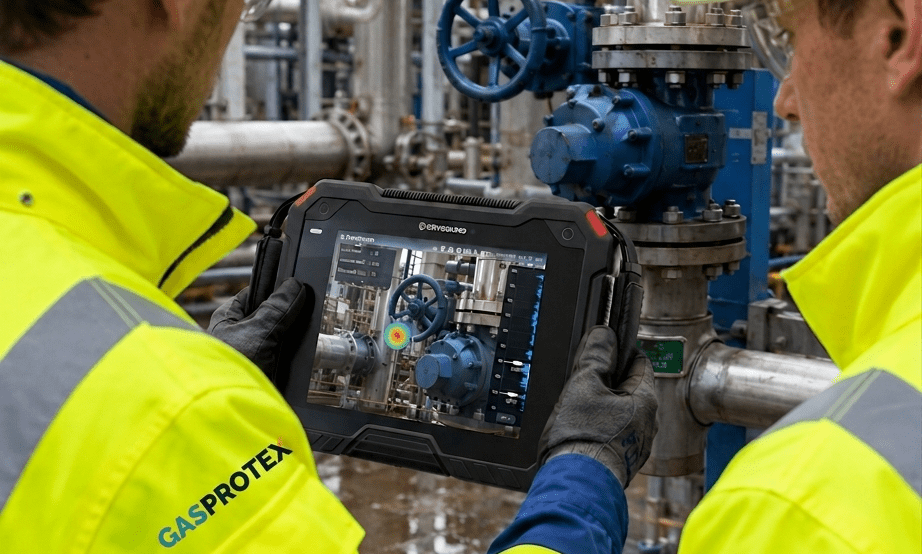
Acoustic (ultrasonic) leak detection in its mobile service form tackles precisely the weakness all the above methods share: coverage. A leak produces ultrasonic sound the human ear cannot hear. With an acoustic camera, an operator walks along the pipework, makes that sound visible, and locates the leak at a distance, without taking the installation offline. (Fixed acoustic detectors exist too, but they again monitor a single zone; here it is precisely the walking of the installation that makes the difference.) This way you scan and analyze the entire installation in one round, including the elevated and inaccessible parts the other methods skip. And because the method registers the sound of the escape itself, it works regardless of the gas: compressed air, nitrogen, and hydrogen too, which an infrared camera does not see.
This method also has a precondition: there must be a pressure difference that lets the gas escape and creates turbulence (and thus ultrasonic sound). A diffuse leak with no appreciable flow you will not hear, and sensitivity decreases with distance and with high ambient noise. No method is universal; the strength lies in combining them.
It is emphatically not a replacement but a complement. Loosely translated into the trade jargon of “hearing, seeing, and smelling gas”:
They do not compete; they cover each other’s blind spots.
For anyone wanting to gauge the coverage gaps in their installation, three questions:
The core: an installation applying all the traditional checks is safe, but not therefore leak-free. Whoever takes energy costs and emissions seriously treats safety monitoring and leak detection as two separate disciplines, and provides for a method that covers the whole installation instead of isolated points.
Marcelinus Verkuil is a gas and leak detection specialist at GasProtex, which provides acoustic gas and compressed-air leak detection for Dutch industry. Get in touch or share figures via our website.
Want to put our expertise to work? Get in touch.