We have fixed gas detection, but where is the leak?
A periodic acoustic gas leak survey finds virtually every leak, including leaks at height and regardless of the gas type. But a survey only finds the leaks that exist on the day of the measurement. A leak that starts a week later keeps leaking until the next round. Of all the leaks that go unnoticed, that is the most persistent category: everything that starts between two inspections.
The usual answer is to measure more often. That helps, but no matter how frequently you measure, a new leak goes unnoticed until the next survey.
The other route is continuous monitoring, and until now that mostly meant concentration measurement: fixed gas detection watching the air at the points where the safety risk is greatest. Indispensable for safety. But an alarm threshold based on concentration stays silent on a small, chronic leak, and when the alarm does go off, it does not tell you where the leak is.
Fixed ultrasonic gas leak detectors have been around for some time, listening continuously for leak noise. They report that a leak has started within their range, but not where the leak is.
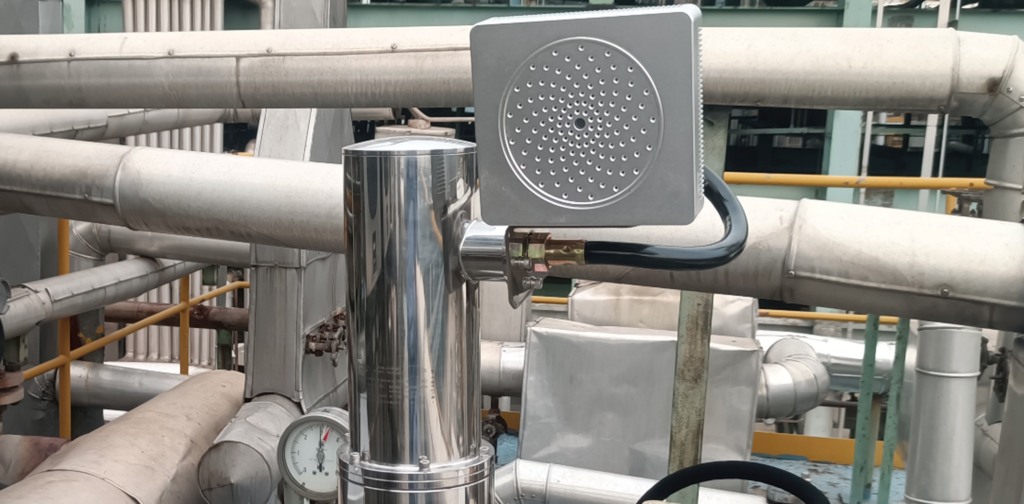
That last part has since changed. There is a fixed acoustic camera that raises an alarm and shows directly on screen where the leak is.
Until now, the acoustic camera has mainly been a handheld inspection instrument: a large array of microphones combined with a video image in a single housing. Permanently mounted, overlooking a wide section of the plant, that same combination works continuously. And because the camera registers the sound of the escaping gas rather than the gas itself, the gas type is not relevant: hydrogen, methane, nitrogen, or compressed air, to name a few.
These fixed cameras are now also available in versions suitable for ATEX zones. That means they can be installed exactly where they are needed most.
The question to ask first is: Which part of your piping and fittings is actually inspected, and how often?
The fixed camera belongs where a leak is immediately dangerous or costly and where the most is therefore at stake between two inspections. Where concentration measurement is already in place, the acoustic camera adds the location, regardless of the gas type. Think of compressor rooms, loading bays, distillation columns, storage tanks, gas metering and pressure-regulating stations, and hydrogen reformers, among others.
The part of the plant not covered by fixed detection remains the territory of the periodic survey. Hundreds of meters of piping still need to be walked, and a camera that sees an entire plant does not exist.
The limits of the method are unchanged as well: acoustic detection only works on leaks under pressure, and the acoustic camera does not measure concentration. Whether a room is safe to enter remains a question for fixed or personal gas detection. So the camera replaces nothing. It prevents a new leak from going unnoticed until the next inspection.
Safety monitoring and leak detection are two separate disciplines. New is the layer in between: continuous leak localisation at the critical points. The periodic survey covers space. Fixed gas detection covers time. The fixed acoustic camera covers both within its field of view.
Marcelinus Verkuil is a gas and leak detection specialist at GasProtex, a supplier of acoustic gas and compressed air leak detection for industry in the Netherlands, periodic inspections, but also fixed installations. You can respond via our website.
Click here for more information about fixed acoustic gas detection!